Jane Shaw’s stories are studded with improbable
criminals, people who seem to be perfectly above board and yet turn out to be
rascals. There are the smugglers that pop up in Bernese Adventure,
Crooks Tour and Sarah’s Adventure. There is the schoolmaster, Mr. Port, in
Threepenny Bit, the elderly and mild-mannered Mr. Runciman in Crooked Sixpence
and the “unspeakable” Dr. Partridge in New House at Northmead. The Susan series
also has its fair share of unlikely crooks. The first one we meet is the petite
middle-class culture vulture Miss Pershore in Susan Pulls the Strings; and a few
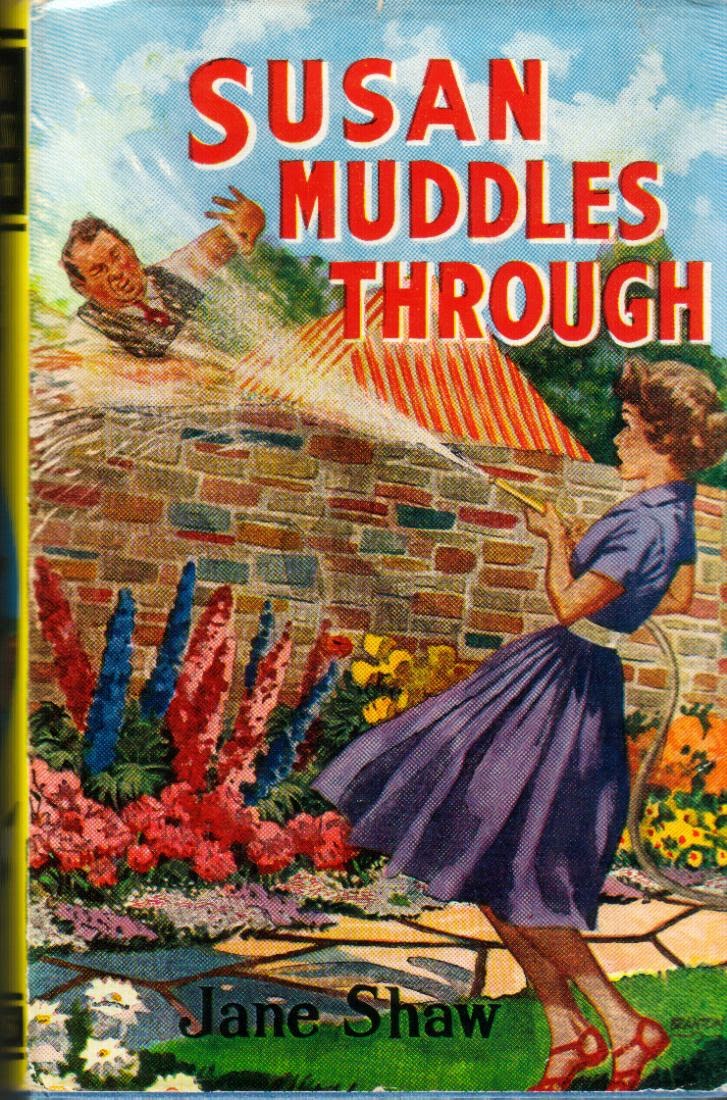
others crop up along the way. Susan Muddles Through has an unlikely defector to
the U.S.S.R., and Where is Susan? has Miss Smith, the beautiful but
unscrupulous stamp collector. But none of these come anywhere as near to surprising
the reader as Miss Frame when she is unmasked as the Mad Collector in Susan’s
Helping Hand. In this multi-layered story, one of the subplots is that someone
is entering houses on wealthy country estates in Kent and helping themselves to
valuable Elizabethan manuscripts. The latest victim, as the story gets under
way, is Miss Folding, who had a priceless letter written by William Shakespeare.
The press dub this thief the Mad Collector, mad because there is no way that these
documents can be negotiated on the open market. The mystery deepens when it is
discovered that rather than a master criminal plotting his thefts with infinite
planning and military precision, the Mad Collector simply rides up to the
mansions on a bicycle, helps himself and casually cycles away. When Bill comes
across the letter tucked into the frame of a map from Miss Frame’s modest
little antique shop, the children suspect her helper and distant cousin, Mr.
Smith. But in the end, Miss Frame herself turns out to be the thief. This is
very surprising because she is a very tiny and very old lady, described as
having silver hair, a pink and white complexion and a “bird-like way”. Susan
and the Carmichaels nickname her the Dresden shepherdess. Her attempt at a
getaway after her unmasking is as dramatic as her appearance. Rather than speed
away in a car or hijack a lorry, she hobbles up to the bus stop. Miss Frame is
the most memorable of Jane Shaw’s unlikely crooks.
Wednesday, September 4, 2013

Quote of the Day
"This washing-up and going out for walks while the grown-ups have forty winks rather takes the gilt off the gingerbread," murmured Midge, but nobody took any notice of her. And Chang went with them for the walk, which made it more interesting, for they kept on having to rescue him from trees and dogs and other people's gardens, and consequently could go neither fast nor far.
From SUSAN PULLS THE STRINGS, Chapter 4, A Blow for Bill.
Saturday, August 24, 2013
Susan Muddles Through
 |
| In Chapter 12 of Susan Muddles Through, Susan finds the proof that Mrs. Macdonald does not owe any money to the crooked old skinflint Cap'n Dan. |
Quote of the Day
Susan gave a little shriek. While certainly enthralled with accounts of the Mad Collector's exploits and eager as she was to be mixed up with any sort of excitement, she hadn't quite bargained for coming to such close quarters with him as this.
"But does that mean, then," said Charlotte slowly, "that Miss Frame is the Mad Collector?"
"That little dainty Dresden shepherdess!" gasped Susan. "Oh, surely not!"
The others began to giggle rather hysterically.
"Well, after all," gasped Midge eventually, "she has a bicycle."
From SUSAN'S HELPING HAND, Chapter 9, Curious Behaviour of an Antique Dealer.
Thursday, August 22, 2013
Threepenny Bit Frontispiece
 |
| A cleaned up version of the frontispiece of Threepenny Bit, showing the shop where the le Roux family open a coin dealer business. |
Quote of the Day
The three girls left her to her sulks. They had already decided that she was homesick - homesickness took people in the queerest ways, everybody knew that - so it was better not to bother her too much but let her thaw gradually.
From NORTHMEAD NUISANCE, Chapter 1, New Girls.
Wednesday, August 21, 2013
Susan Reels Back
 |
| An illustration from Susan and the Home-made Bomb. Susan reels back as she enters the Gascoignes' rumpus room. The smell of Peregrine's chemistry experiment is too much for her. She describes it as a mixture of rotten eggs, drains and a dead rat. |
Bill's Hobbies
Throughout the Susan series, Bill Carmichael is renowned for being mechanically minded and good with his hands. He makes a special flap in the kitchen door to allow Susan's cat Chang to come and go at will and often works with Meccano models. However, in the last two books of the series, he takes an interest in philately and starts to build a stamp collection. A friend of his from school called Stobbs helps him. The stamp collecting ties in nicely with the fact that Susan and Midge are pursued all over Venice by desperate stamp traders in search of the Shilling Deep Green. It is Bill and Stobbs who confirm the value of the stamp by telegram.
Quote of the Day
Shirley looked at her coldly. "I think that you can leave Gabrielle in my hands now, Susan, don't you? I'll see that she does all the proper things."
Susan meekly said, "Yes, Shirley, of course," and thought with envy of a cosy tea by a study fire with, probably, luscious cakes - a first-day privilege for prefects - and dismally of common-room tea of cocoa, and buns known as Brother Where Art Thou, on account of their shortage of currants.
From SUSAN'S TRYING TERM, Chapter 1, New Girl.
Tuesday, August 20, 2013
Susan and the Spae Wife
 |
| A queue forms outside the spae wife's tent at the fête. But Mirren the spae wife will be taken ill and Susan will step into her shawl. |
Quote of the Day
"Only four of them!" Caroline would say in surprise, discussing them with Sara and wondering why, for all their good-nature, they didn't like them better: "they always seem to be more like a dozen to me."
"Maybe it's the comic times they visit at that annoys us," Sara suggested. For the Duvals had a curious habit of paying a morning call just when Louise had announced lunch. They would swarm in, kiss Madame many times on each cheek (and Sara always insisted that once she saw Miette kiss her on the back of the neck when she couldn't get in at the front).
From BRETON ADVENTURE, Chapter 4, Sara Catches a Burglar.
Monday, August 19, 2013
Places in Jane Shaw: Venice (The Tetrarchs)
 |
| On the way out of St. Mark's in Chapter 4 of Where is Susan, Miss Thornton introduces Susan to the Tetrarchs. Susan describes these porphyry figures as "such dear little chaps". |
Jane Shaw Encyclopedia: Miss Thornton
Miss Thornton is
an artist who appears in Where is Susan? When Susan and Midge are entering St.
Mark’s, the “beautiful Russian spy” is turned away by the beadle. A tall
Englishwoman carrying painting gear explains to the girls that the spy’s entry
is barred due to her inappropriate backless dress. Susan decides that this
woman is a schoolmistress. On the way out, in an attempt to avoid being detected
by the mysterious spy, Susan and Midge separate and Susan latches on to this tall
woman and borrows her stool to use as a “hat”. Her suspicion that the woman is
a teacher is apparently confirmed when the woman corrects Susan’s grammar. The woman
thinks that her new companion’s behaviour is rather odd but takes a liking to
her and offers to see her safely to the pier where she has arranged to meet Midge.
She is surprised by Susan’s knowledge that the horses at St. Mark’s are Greek
and gives her a charcoal sketch that she has made of the statues. Susan is delighted
and grateful as they part company. Later, when Charlotte sees the drawing she
informs her cousin that her new friend is no school teacher. She recognizes the
signature, Thornton, as being that of a very famous artist, a woman far above
the class of the Gascoignes’ stepfather, Sam Pilkington. At Selina Gascoigne’s
party, Miss Thornton is happy to see Susan again and describes her as a friend,
which has Gabrielle seething with jealousy. Miss Thornton is important to Susan
because of the drawing (which she cherishes and has framed) and the fact that
she provides Susan with one of the few opportunities she has to get the better
of Gabrielle.
Quote of the Day
There were two things that worried Penny when she went up to bed in her turret room at last, worn out with excitement and that most exhausting evening. She could not find the roll of exposed film that she had seen when she had come upstairs to fetch the torch; and she wondered why there had been a Loden cape hanging over the back of a chair in a dark corner of the kitchen.
From FIVEPENNY MYSTERY, Chapter 4, The Stranger Comes.
Sunday, August 18, 2013

Quote of the Day
"I saw him," said Robert. "At least I saw a man row away from Belinda and I rowed after him, dodging and keeping in the shadows - I liked that - and he went on board the Miranda, which was moored in Luss Straits, and then I came back to Belinda for my book and went and stepped in the blooming old paint, or you'd never have discovered me-"
"Oh yes, we would," said Pips.
From THE CREW OF THE BEINDA, Chapter 16, The Footprint of Blood.
Saturday, August 17, 2013
Crooks Limited
 |
| The last illustration in Crooks Limited, when Ricky and Fay tumble out of the wardrobe. Throughout the story, the artist mixed up Ricky and Fay, making Ricky a brunette and Fay a blond. Other than that, the story is very good. |
Quote of the Day
Ricky, ready to promise anything, bolted her apple dumpling, normally one of her favourite puddings and one that she liked to linger over, and flew to the telephone. She rang Fay, the more hopeful, first, and poured a confused jumble of excitement, hopes, fears and sheer rubbish into her ears.
From CROOKS TOUR, Chapter 1, Excitement at Last?
Friday, August 16, 2013
The Matchmakers: Tina
 |
| Tina is caught on the mountainside and is spotted by a troop of baboons. This story is the only Jane Shaw short story set in South Africa. It was published in the Collins Girls' Annual 1959 and lavishly illustrated. |
Quote of the Day
For one awful moment I thought that Madame was going to burst into tears. Her face sort of puckered up and her eyes went all dewy. Then she held the puppy up to her face. He put out a tongue and licked her, and she laughed rather shakily, and came out with a great long excited speech like a burst of machine-gun fire. There was a rather long pause, then Clarissa said, "Oui."
We then beat a hasty retreat.
"Cluck, did she like him?" Thomas said.
"Oui," said Clarissa.
From LOOKING AFTER THOMAS, Chapter 5, Thomas's Catch.
Thursday, August 15, 2013
Jane Shaw Encyclopedia: The Splinter of Glass
The Splinter of
Glass is a play written by Miss Maxwell-Perry, the new English teacher
at St. Ronan’s, in Susan’s Trying Term. It is based on Hans Andersen’s Snow
Queen. The leading role of Kay is given to Gabrielle Gascoigne and the part of
Gerda goes to Susan’s friend Elizabeth Rogers. The play is described as
poetical in some parts and "screamingly funny" in others. On the night it is
performed, The Splinter of Glass is attended by influential friends of Selina
Gascoigne’s: Lady Harrington, Julian Barwith and Tony Cassel, the latter two
being producers. Mr. Barwith is so impressed by the play that he decides to
produce it for a television broadcast. He wants to transport the play to London
but is convinced by Miss Phillimore, the head mistress at St. Ronan’s, to film the
play at the school. The play is broadcast live on the last day of term.
Quote of the Day
Midge wondered if she was Italian, but her neighbour, when she asked him, said not. Russian, he thought, but he spoke so slowly and oddly that Midge turned sharply to look at him. He was slumped forward in his seat, his arms dangling. Oh help, she thought, what next? With quite an effort she heaved him up again. "Aren't you feeling well?" she asked him.
"I think I've been poisoned," he said, slurring his words.
"Oh, go on with you," said Midge, "I thought the snacks were delicious.
From WHERE IS SUSAN?, Chapter 1, Sunday, September the Third.
Tuesday, August 13, 2013

Quote of the Day
"Goodness, I do think the French are nice," said Ricky, as they hurtled down through the streets of Montmartre towards the Rue du Mont Thabor, carefully enunciated to the taxi-driver at least five times. "So kind and trusting."
She changed her tune a little when the taxi-driver, not pleased with his tip, shouted furiously after them as they ran blushing into the hotel. "Well, mebbe they're not all kind," she said as the driver's furious yells made the girls wince painfully. "But at least Madame Raoul up at Montmartre is---"
From CROOKS TOUR, Chapter 7, On to Paris.
Monday, August 12, 2013
Jane Shaw Encyclopedia: Elizabeth Rogers
Elizabeth Rogers
is a pupil at St. Ronan’s. She has black hair and is known to her friends as
Liz. She appears in all three stories set at the school: Susan’s School Play,
Susan at School and Susan’s Trying Term. She was a friend of Midge’s before
Susan and Tessa’s arrival at the school and becomes friends with both of them
too. In Susan at School, Elizabeth joins
Susan, Midge and Tessa when they go to House Night as the Loch Ness Monster, which
they refer to in code as the L.N.M. to avoid other pupils knowing about their
idea. When Susan discovers what she thinks is the school’s famed lost treasure,
Ronan’s Heap, Elizabeth identifies one of the pieces as a Georgian copper jug. Elizabeth’s
greatest attribute is her acting skills. However, she often loses the best part
in plays to Hermione Pennington-Smith, a spoiled prefect who is given the roles
because her father is Clerk to the Governors. However, the teaching staff will never
admit that the reasons for not giving the part to Elizabeth are political. In Susan’s
School Play, Elizabeth is passed over for the role of Ariel in The Tempest and
the mistress in charge, Miss Crumbles, explains that it is because Elizabeth is
young and has more years ahead of her for leading roles, while Hermione is in
her final year. However Liz is called in at the last moment to replace
Hermione, who unbeknownst to everyone else, has been locked up in a shed by
Peregrine Gascoigne. Liz gives a brilliant performance. In Susan’s Trying Term,
Elizabeth is passed over yet again in favour of Gabrielle Gascoigne, who is
awarded the leading role in The Splinter of Glass by Hermione (who seems to
have had a year added on to her school career). But Liz shows little resentment
and is happy to have the part of Gerda in the play. Again, she gives a brilliant
performance. Liz hopes to go to drama school, although her grandmother is
opposed to this plan. However, after a television producer decides to film the
play for the small screen, everyone is sure that the grandmother will relent and
let her pursue her dream. Elizabeth is very dedicated to acting and, much to
Susan’s bewilderment, can often be found rehearsing in a corner all alone and
learning chunks of poetry for the fun of it. She also has an internal alarm
clock that never fails. She tells herself what time she wishes to wake up and
she does. Susan describes her as a “first-class waker-upper”. She is also
generous with chocolate.
Quote of the Day
Tessa seemed to be taking this criticism very calmly - mainly because she had not heard it. She sat and fiddled with the potato peeler which she was supposed to be using to gouge out the inside of the turnip. "What I can't understand," she said, "is why Susan wakened me up to tell me that there was a fire in the museum when all the time there wasn't. I've been puzzling about it ever since..."
From SUSAN'S TRYING TERM, Chapter 10, Hallowe'en.
Sunday, August 11, 2013
The Tall Man

This is the frontispiece of the last of the Thomas books, The Tall Man, published in 1960 by Nelson.
Quote of the Day
In New House there was a lone survivor too. Celia Manson, although she was in the same form as Fiona and Katherine, being in a different house, didn't know them very well, and she was feeling definitely unnerved at the thought of at least a fortnight's quarantine in their alarming company. After all, not only were they cousins and as thick as thieves, they were the Moochers, who although they had only been a year at Pendragon Manor had made such a stir that their fame - at one time their ill-fame - had penetrated to all the other houses. One way and another Celia, who was a gentle and diffident creature, looked forward to a few weeks in their company much as she would have looked forward to a fortnight spent with a couple of Gorgons.
From THE MOOCHERS ABROAD, Chapter 1, Three Letters.
Saturday, August 10, 2013


Quote of the Day
Bill insisted on taking Susan immediately to the back door to show her a little swinging panel that he had made in it for Chang, so that he could get in and out when he liked without the door being opened. Susan thought it was extremely clever and the neatest little gadget she had ever seen, and was sure that Chang would like it as much as she did, if not more.
From SUSAN PULLS THE STRINGS, Chapter 2, Troubles.
Friday, August 9, 2013

Quote of the Day
Susan and the Carmichaels were strongly against going to the wedding at all.
"I'd rather go to the pictures," said Midge at breakfast that morning.
"Dressing up on a Saturday!" said Bill.
"Weddings make me cry," said Charlotte. "But not Selina's."
"Do we have to go?" Midge muttered.
"Well of course," said Aunt Lucy firmly. "We were invited. We accepted. Naturally we must go. Besides," she added unwisely, "you'll enjoy it."
From SUSAN MUDDLES THROUGH, Chapter 1, The Wedding.
Tuesday, July 30, 2013

Friday, July 5, 2013
Quote of the Day
Elizabeth Rogers had black hair and was a friend of Midge's; she was a wonderful actress, Midge said, and was often to be seen in a corner of the Dragons' common-room with her fingers stuffed in her ears learning chunks of poetry for the love of it which seemed to Susan and odd way to behave; Ann Burton had a lisp; Gail Martin had specs which Susan took to cleaning every morning before breakfast - she sometimes wondered how Gail had managed before her arrival, she must have seen everything through a sort of fog; Mary Roseveare was bursting with brains and got an A every time in the fortnightly marks, Bridget Phillips was anything but-.
From SUSAN AT SCHOOL, Chapter 2, Super Fags. Here we are introduced to Susan's new friends at St. Ronan's. Elizabeth Rogers had already appeared in the short story Susan's School Play when, thanks to Peregrine of all people, she managed to get the leading role in the play, replacing the much villified Hermione Pennington-smith, whose disagreeable father was Clerk to the Governors. Elizabeth would appear in a number of scenes in the St. Ronan's stories. Ann Burton's lisp was used to great comic effect in both books, but was not overused. The other girls did not make many appearances. With all the teachers, prefects and other pupils, St. Ronan's was a crowded scene, especially after Gabrielle Gascoigne moved there in the second term of Susan's first year.
Wednesday, June 26, 2013

Quote of the Day
"Will it feel nice to be on your native heath once more, Susan?" asked Uncle Charles.
"Aye, it will," said Susan, going rather Scots at the very idea, "but I like it fine here too."
For Susan was Scottish, although at this time she was living at Wichwood Village, near London, while her parents were in South Africa.
From SUSAN MUDDLES THROUGH, Chapter 1, The Wedding.
Sunday, June 23, 2013
Quote of the Day
"Taking photographs! Really, Susie, of all the cheek! Bad enough searching the girl's room without stopping to take photographs!"
"It was lucky I did," said Susan. "If I hadn't been taking photographs, I wouldn't have been on the balcony when this dreadful little man came in. Actually I was scared stiff, it was awful, and then hangning onto that door like Kate Bar-lass in the history books-!"
Midge and Charlotte had never heard of Kate Bar-lass, and promptly assumed that she appeared in Scottish history, everybody knew that the Scots were a wild and barbaric lot, like Susan, catching hotel-thieves single-handed.
From WHERE IS SUSAN?, Chapter 13, Susan Takes Some Photographs.
Saturday, June 22, 2013

Quote of the Day
When Lise had found a parking-place for her car she went to the police headquarters. The police were very soothing, and told her that lost little boys always turn up.
Not if they're being kidnapped, Lise thought to herself, but she didn't say it aloud because she did not want to start explaining that one to the police.
From SUSAN INTERFERES, Chapter 11, The Search for Rudi.
Friday, June 21, 2013

Quote of the Day
"You have got a partner, you know," Jennifer remarked acidly as Sheila, poaching shamelessly, won the point and the game.
"Sorry," said Sheila carelessly as they changed ends. "But we did win the game."
"We might still have won it if I'd been allowed to hit the ball occasionally," said Jennifer, a mild girl until roused, "without you jumping from side to side like an electrocuted flea."
Kay, walking round the far side of the net with Nicky, stuck an elbow in her ribs. "Spot of trouble over there," she said, jerking her head towards their opponents.
"Jenny's as mad as a snake," said Nicky, pleased.
"Send everything to Jenny then," said Kay, "and see what happens."
From NEW HOUSE AT NORTHMEAD, Chapter 13, Tennis Matches.
Thursday, June 20, 2013
Quote of the Day
When Penny next opened her eyes, Mrs. Fergus was standing smiling by her bed, a loaded tray in her hands.
"Och, your father got his bus quite the thing," she was saying, "and a real nice morning her got for the crossing. And did you sleep well, my wee lassie?"
"Yes, no - well, I must have, I suppose, thank you, Mrs. Fergus," said peeny, "but there was a most extraordinary noise like a - like a - well, I don't know what it was like, a kind of croaking-"
"Och, that would be the old corncrake," said Mrs. Fergus, "over in the hayfield. Whiles we are fair deeved with his noise...."
From PENNY FOOLISH, Chapter 2, The Minister's Children.
Wednesday, June 19, 2013
Walk Along the Seine
 |
| A cleaned up scan of an illustration from Chapter 9 of Anything Can Happen. Dizzy and Alison walking along the Seine. |
Quote of the Day
"If you emptied the w-w-water out of your b-b-boots," Aunt Lucy began. She helped Susan to pull off her boots and Susan poured out a stream of muddy, dirty, icy water. Then she put her boots on again and began to lumber back to the house. She had never felt so cold in her life. She began to remember horrible stories of frostbite and wondered how soon she could expect her nose and fingers to drop off. She had no feeling in any of them at all - for all she knew her toes might be off already.
From SUSAN PULLS THE STRINGS, Chapter 7, Chang Breaks the Ice.
Wednesday, May 1, 2013
Willow Green Mystery illustration
 |
| A case of mistaken identity. Tish whacks Michael over the head with a huge branch in Lost Boy Number Two, the seventh chapter of Willow Green Mystery (1958). |
Quote of the Day
But Monsieur Bossuet was muttering, "Charming... charming... more than charming: form, line, colour, strength, major talent..." Then abruptly, "I will give you fifty thousand francs for this picture. Will he sell, your friend in Montmartre? Are you authorised to sell this picture?"
Fifty thousand francs! Would he sell! Were we authorised to sell? Jean-Jacques had never sold a picture in his life.
From THE PICTURE, a short story published posthumously. You can read a review of this story here.
Friday, April 26, 2013

Quote of the Day
They were all perfectly well behaved except that madcap Sambo. He was off and up over a little hillock before you could say knife. We thought Dotty had lost him forever. But of course we had armed ourselves with a spare bit of chocolate left over from yesterday. Dotty put down such a huge lump that even Sambo couldn't resist it. He came over a hummock, his nose twitching with delight, and ate himself practically into a stupor. He was no trouble, Dotty said, on the way home.
From A GIRL WITH IDEAS, Chapter 4, King Arthur Lived Here.
Sunday, April 21, 2013
The Attack
 |
| From Susan's Trying Term. Susan attacks Gabrielle because of one of her dirty tricks. Like many of the illustrations in the Susan stories, there is a goof in this one. On the front cover, when Gabrielle arrives at St. Ronan's, she has very short hair, but after only a few weeks her ponytail has grown back! |
Quote of the Day
Gabrielle wasn't much interested in smugglers when she heard about the night's activities the next morning; anything in which she wasn't directly concerned had very little interest for her. But because the Bird-watcher had obviously taken a fancy to Charlotte, she said maliciously, "I don't know whether he's a smuggler or not, but the Bird-watcher is certainly bogus."
From SUSAN MUDDLES THROUGH, Chapter 6, Investigating Cap'n Dan.
Thursday, April 18, 2013
Susan's Trying Term
 |
| This is a huge scan of the cover of Susan's Trying Term (1961). The spine shows the unlikely scene of Susan wiping a painting with a turpentine-soaked rag and discovering a long lost masterpiece underneath, while the front cover shows a rare comment on the changing fashions of the day. Susan and her friends retain their "sensible" girlish 1950s hairdos, but Gabrielle has lost her much maligned ponytail and cut her hair short, which meets with the disapproval of the other characters. In her previous stories, Jane Shaw had, through her characters, complained a great deal about girls and women wearing trousers, especially Selina and Gabrielle Gascoigne, and (for reasons best known to herself) girls with ponytails. In 1962 she relented on this latter point when one of her best-loved characters, Ricky from Crooks Tour, was given a ponytail. All this may seem a bit strange today, but when I was a child it was strictly forbidden for girls to wear trousers at school. I remember in the late 1970s a girl in my class coming to school in trousers and her mother insisting that it was too cold for her to wear a skirt. The teacher finally agreed to the trousers as long as she wore a skirt on top of them! Even into the 1980s this ban continued. I recall how a girl at a school near mine incurred the wrath of a traditional female examiner when she turned up for her Higher English test in jeans and was "banned for life" from Scottish Certificate of Education exams as a result. However, I'm sure such a ban could never be enforced. But that was what it was like back then. |
Quote of the Day
By this time they had circled round Tugela Road, along Congo Road, and were about to come down Orange Road to Nile Road. A very ragged native boy leading a pony was leaving the road to go across the koppie when Susan rushed at him, barking loudly.
"Susan! Bad dog! Come here!" called Belinda.
Mike rushed up and seized Susan's collar. "It's all right," he assured the native boy, between barks, restraining Susan with difficulty, "she - isn't - savage - really - she only - looks - savage!"
From VENTURE TO SOUTH AFRICA, Chapter 8, Enter Stella. Susan, of course, is not Susan Lyle, but the Eliots' Airedale. Both Susans were created around the same time, in the early 1950s. Although only published in 1960, Venture to South Africa was actually written soon after Jane Shaw and her family moved to Johannesburg in 1952. Lutterworth bought it in 1953 but never published it. Her editor at Nelson Publishers purchased the manuscript in the late 1950s and made sure that it was put into book form.
Wednesday, April 17, 2013
Something Happened After All: Jane Shaw in the 1960s
 |
| This is the cover of Nothing Happened After All, the second of the Dizzy and Alison books, published by Collins in 1965. Jane Shaw's heyday was certainly the 1950s in terms of sales. But she was just as prolific, if less successful, in the 1960s. We often talk of her winding down her career in the sixties, but when you add it up, she produced an admirable number of books during her last decade as an author. The Moochers and Penny series had drawn to a close, but the Susan series continued, albeit with less frequent publications and fewer sales. The sixties also brought the two Northmead books, Crooks Tour, Brer Rabbit, Left-Handed Tumfy and the Dizzy and Alison stories. There were also the two Spitfire paperbacks under the pen name of Jean Bell. Despite all these publications, her sales diminished as the years passed and her publishers do not seem to have gone out of their way to advertise her stories. Another factor that helped to keep her out of the limelight is that she stopped publishing short stories in the Collins annuals after 1963. My favourite story of hers was her last, A Job for Susan, published in 1969. It is admirable that the quality of her writing never diminished over the thirty years that she was a published author. There were minor hiccups like The Crew of the Belinda, and even a couple of dodgy short stories like The Onion Man, but in a general sense the quality of her writing was very high. |
Quote of the Day
A pretty woman, chattering Italian with an English accent, accompanied by a young girl and a small boy, all chattering, asked, "Where is Susan Lyle?" The small boy was fidgeting with pens and register on the desk all the time that they chattered and finally knocked over a bottle of ink, so the reception clerk had the greatest pleasure in telling the whole chattering crew that no one of that name was staying in the hotel.
From WHERE IS SUSAN?, Prologue. The crooked desk clerk throws the Gascoignes out of the Hotel Soldati.
Saturday, April 13, 2013

Quote of the Day
But for this night only, as Madame said when they sat down to dinner, they would speak English, although from to-morrow she dared them to let her hear a word of it, for how furious their dear parents would be if they returned to Scotland with their French no better than when they came!
From BRETON ADVENTURE, Chapter 1, They Arrive. Poor Madame at this point does not know that no matter how long they spend in France or Switzerland, none of Jane Shaw's characters would ever become fluent in French. Only Charlotte Carmichael, who went to study art in Perugia, would learn a foreign language, being forced to gain a little fluency in Italian.
Friday, April 12, 2013
Susan and the Spae-Wife
 |
| The heading and first illustration from the last of the Susan short stories, Susan and the Spae-Wife, published in the Collins Annual in 1960. This story is set on Arran just after Susan Muddles Through, following the departure of the Gascoignes after their two-week sojourn on the island. But if Susan is hoping for peace and quiet after the Ghastly family have left, she is in for a shock. The post office is held up and the fair is to be visited by the famous writer, Mr. Rock Carlisle. For further information about this short story, click here. Click on the picture for a much larger view. |
Quote of the Day
The school reports really started it all: Susan's and Midge's were uniformly poor, but in French they both reached new depths. Aunt Lucy read them with gloom. "'Midge is lazy and inattentive...' really, Midge!"
"Susan's is worse." Midge produced the diversion hopefully.
"It worked. Aunt Lucy turned to Susan's report.
"'Susan is apparently too occupied with other things to bother about French. A very bad term's work,'" Aunt Lucy read out.
"Sarcastic old pig," said Susan. "Just because I had to do my maths prep during French once or twice-"
From SUSAN'S KIND HEART, Chapter 1, Haunted Château. I often wonder why Susan and Midge's parents spent so much money on private school fees for them, when they obviously learn next to nothing, and then "punish" them by sending them to France for the summer!
Thursday, April 11, 2013
The Wilsons Won't Mind
 |
| In the first of the Susan short stories, The Wilsons Won't Mind, set between Susan Pulls the Strings and Susan at School, Charlotte's latest craze is cooking. Unfortunately, her artistic skills do not extend to the kitchen and the result of her cooking is an inedible disaster. The Wilsons Won't Mind is the only one of the fifteen Susan stories not to include the main character's name. It was first published in 1955 in the Collins Girls' Annual. It was republished in Collins The Treasure Book for Girls in 1958 and another collection in 1982 called Ballet Stories. Its final appearance was in Susan and Friends in 2002. The story has all the hallmarks of a Susan story, but is pretty run of the mill. Susan's School Play and Susan and the Spae-wife are better in my opinion. |
Quote of the Day
However, it was a nice, mild June evening, the girls were in no particular hurry to reach home as they would immediately be forced by their mothers to do a lot of boring home-work when they got there, so they strolled on to the next bus-stop. Fay, of course, was right; they were mid-way between stops when the bus sailed past, and the argument started again at the next stop.
From Crooks Limited, the 1962 short story featuring Ricky, Julie and Fay, of Crooks Tour fame.
Wednesday, April 10, 2013
Fourpenny Fair illustration
 |
| A picture from Fourpenny Fair. Penny and Sid put up a sign at the fair advertising the orphans' play. |
Quote of the Day
Penny became even more gloomy. Honestly, she thought, life was too awful. Here she was, happily spending the Easter Holidays with Laura and John, doing nobody any harm, when suddenly this ghastly Talents Contest loomed up. Talents! What talents had she, she would like to know? Everybody knew that she was absolutely hopeless at everything - not like Jill, who was jolly good at everything, though a year younger. "I don't know what I'll do," she said. "I haven't any talents-"
"Well, we all know that, bird-brain," said Jill, "but I expect we'll be able to think of something that even you can do."
From FOURPENNY FAIR, Chapter 1, Fourpenny Fund. Penny has a trying time with Jill's insults.
Tuesday, April 9, 2013
Willow Green Mystery illustration
 |
| An illustration from The Chink in the Curtain, Chapter 4 of Willow Green Mystery. Thomas suspects that the house is occupied by "sinister Russians". |
Quote of the Day
"Where shall I begin?" I said.
"Begin at the beginning," said my sister Clarissa, who can be rather nippy at times.
"But what is the beginning?" asked Tish. "Is it when we found the boy lying dead in the ditch?"
"Only he wasn't dead," muttered Thomas. (This seemed to be a disappointment that he wasn't going to forget in a hurry).
From WILLOW GREEN MYSTERY, Chapter 1, Boy in the Ditch.
Sunday, April 7, 2013
The Blot
 |
| This is a "cleaned up" version of an illustration from Northmead Nuisance. The ugly prefabricated building on the school premises is known to the girls as The Blot. It is destroyed during a storm. Northmead Nuisance is the second and last of the Northmead books and was published by Thomas Nelson & Sons in 1963. |
Quote of the Day
The Moochers, having finished their packing, had permission to go down and say good-bye to the Pengellys, or to Mrs. Pengelly, rather, for they would see Mr. Pengelly later when he helped to convey bus-loads of Pendragons to the station. Mrs. Pengelly, true to form, had made them each a saffron cake to take home for Christmas.
"That's a real Cornish cake, a 'zaaffern caake'," she said. "I promised Jan I'd make you a Cornish cake. We'll miss you popping in, but you'll soon be back. Do you remember the first time you came - you didn't like Pendragon much then, did you?"
"Oh, we were potty," said Fiona.
From THE MOOCHERS, Chapter 11, The House Shield.
Friday, April 5, 2013
Grey Suit
 |
| A scene from Show-Down, Chapter 14 of Anything Can Happen. Alison returns to the hotel to find the evil Grey Suit ransacking her room and brandishing a gun. But Pierre and Monsieur Chanel are right behind her to make sure that he is arrested once and for all. |
Quote of the Day
The hotel-keeper, a jolly little round man, wearing braces embroidered with edelweiss, gave them a tremendous welcome. He talked very fast, inaccurate English, and told them of the many amenities Rosenberg had to offer - the river and the small lake and mountains, so many, so high mountains, why, look there, face to face with them was the mountain called the Eiger, that terrible north wall of the Eiger which for many years no one had climbed, he had a book of cut-outs from the newspapers telling of the many times that men had not climbed it.
From CROOKS TOUR, Chapter 3, Crook in the Hotel.
Saturday, March 30, 2013
Susan Interferes
 |
| The huge scan of the Children's Press laminated board edition of Susan Interferes with spine, circa 1965. |
Quote of the Day
Apparently the cold weather had decided to reform, because when they woke on Easter Day, the sun was shining madly and the birds were singing madly too, and there were boiled eggs for breakfast, gaily-coloured, pink and green and yellow. There were other eggs too, Easter eggs - big chocolate ones from Dr. Carmichael, with chocolates inside; and cardboard ones decorated wth rabbits and lambs and yellow chickens with presents inside from Aunt Lucy, and the little presents that they had given each other.
From SUSAN'S HELPING HAND, Chapter 6, Susan is Inquisitive.
Saturday, March 23, 2013
Northmead Nuisance
 |
| The frontispiece of Northmead Nuisance. The normally taciturn A. J. Wotherspoon confronts Gail about her selfishness. |
Quote of the Day
Here was a fix. They couldn't take an infectious Deborah across Europe, giving her germs to every child they met; Frau Walther at the Gasthof Alpenrose hadn't a corner to offer them. But when the Gräfin heard, she laughed. "Everybody will pack up and come to us," she said. "It is very appropriate that you should be our firsts guests at the Schloss Adlerhorst, new style!"
From FIVEPENNY MYSTERY, Chapter 13, Rescue.
Thursday, March 21, 2013
Laminated Boards
 |
| Last week I received an e-mail inquiring about the different editions of the Susan books and whether the Children's Press editions had illustrations and dust jackets. I never really used to give much thought to the editions. As I live in Brazil, there's no way I can go around charity shops and second-hand book stores to compare editions, etc. When I started collecting Jane Shaw, I was happy just to get my hands on the books and read the stories. But after a while I began to take an interest in the editions. The original Collins books were often lavishly illustrated and even had colour frontispieces. The original Children's Press books from the late 1950s had dust jackets but were often bereft of illustrations. My copy of Susan's Helping Hand, for instance, has a DJ but no internal pictures. My Seagull Library edition of Susan at School has the illustrations and DJ, but no frontispiece. The same goes for Susan Muddles Through. From Susan's Trying Term onwards, all my books are original Collins editions and I don't imagine they were issued in any other format. However, in the mid to late 1960s, several of Jane Shaw's books were issued in cheaper hardbacks with laminated boards. They had no internal illustrations, but the covers are very colourful and lively. I have Susan Rushes In in this edition and also Crooks Tour. The Jane Shaw books issued in this format are: Susan Pulls the Strings Susan's Helping Hand Susan Rushes In Susan Interferes Crooks Tour All of Jane Shaw's books published by Nelson (Penny, Thomas, Dizzy and Alison) were never issued in cheaper editions. Collins, obviously set on getting as much mileage as possible on the stories, also considered putting out the early Susan stories in Armada paperbacks in the 1970s, but for reasons unknown this idea was shelved. |
The Mysterious R. H.
In Susan at School, Susan and Tessa come across an old map in the library. It is a map of St. Ronan's from long ago and on the map a cryptic message has been scrawled: R. H. Here. The girls decide that it is the hiding place of the legendary treasure known as Ronan's Heap, hidden from the messengers of King Henry who went about the country dissolving the monasteries and plundering their treasures. The hunt for the treasure culminates in a hilarious scene in which the girls dig up rusty old kettles and pap boats. However, a couple of questions are left unanswered. First of all, who wrote the mysterious message and why didn't he go and dig the "treasure" up himself? Susan and Tessa do indeed give some thought to this, with Susan reaching the conclusion that the unhappy treasure hunter of yesteryear died, possibly of old age, before he had a chance to get his hands on the gold and jewels. After feeling sorry for this person, the girls give him no further thought and concentrate on digging. But who wrote the message in the first place? I imagine a former pupil on a rainy afternoon puttering about in the library and doing it for a joke, maybe smiling at the idea of a future pupil taking it seriously. And did Ronan's Heap really exist to begin with? In Jane Shaw's world, it would be safe to imagine that it did, and that Susan was meant to find it in a later story. The author undertook to write four or five books set at St. Ronan's, although only two ever materialized, and I can imagine the treasure being found. In The Moochers, Fiona and Katherine found the famed Pendragon Hoard, so there would be a good chance of Susan uncovering Ronan's Heap in her blundering way.
Quote of the Day
"Oh goodness, I shouldn't think so," said Aunt Lucy distractedly, "I promised to make ten pounds! Here, have a look at the leaflet, it tells you all about the fête." As if she was going to make the sweets that minute, she stuffed her last piece of toast in her mouth and got up. "Oh, and don't forget to tell the Gascoignes about the fête - they might like to come and I told Mrs. Mountford-Jones that I'd bring as many people as I could--"
There were rebellious mutterings and angry murmurs from the family. They couldn't even enjoy a fête without these Gascoignes, it seemed.
From SUSAN RUSHES IN, Chapter 5, Buried Treasure.
Wednesday, March 20, 2013
Anything Can Happen illustration
 |
| A scene from Chapter 11 of Anything Can Happen, Madame Bertholet Regrets... Dizzy and Alison enjoy a surprisingly friendly chat with the concierge at Madame Bertholet's block of flats. |
Quote of the Day
Well, of course, everything now was absolutely clear. Really, this bracelet was creating quite a disturbance. Fancy old Grey Suit padding up and down the Rue de Rivoli for - how many days was it? - on the off-chance of seeing us again! Which of course he had, often. It wasn't so surprising, really, when you think how we haunted that street. I blushed to myself for having the conceit to think that Grey Suit was following us for our irresistible beauty, so I quickly said, "Oh, Monsieur, but of course. Of course we'll bring back the bracelet. As a matter of fact, we saw your---"
"We'll bring it tomorrow," Dizzy interrupted firmly.
From ANYTHING CAN HAPPEN, Chapter 9, Up Among the Gargoyles.
Saturday, March 16, 2013

Susan at School (Review)

The story begins
with Aunt Lucy dropping Charlotte, Midge and Susan off at St. Ronan’s.
Susan is soon introduced to many of the most memorable characters in the series.
First of all, there is her dreamy friend and fellow newcomer, Tessa. Then there
are Charlotte’s fellow prefects, the boisterous but likeable Hippo and the nasty
Hermione Pennington-Smith, known to her many enemies as H. P. Sauce. Susan also
befriends Ann Burton, the girl with a lisp, and Elizabeth Rogers, the budding
actress. However, and unusually, it is on Susan and Tessa that the story mainly
focuses, with Midge in many chapters taking a back seat. Other characters that are
still remembered years later by readers are the teachers: Miss Phillimore, the
imposing head mistress, “Dotty” Johnson, the Latin teacher and the dreaded Miss
Ferrier, a.k.a. the Ferret, the maths mistress.
The story that
follows is one of Jane Shaw’s most humorous and is also interesting because it goes against the grain of the school story genre. The girls do not form a tight bond
with the school. They tend to be underachievers and very little learning takes
place. They go through prep and classes with the minimum possible effort. But Susan
does win her place on the hockey team and is anxious to help provide funds for
the new and badly needed school hall. Not surprisingly, there is a long-lost
treasure supposedly buried on the school grounds that can help achieve this. And
there is the added mystery of dotty Miss Johnson’s mysterious comings and
goings to an old shed.
Unlike other Jane
Shaw stories, this tale thrives on anti-climax. Miss Johnson’s supposed secret
has Susan and Tessa chasing all over the place, but turns out to be an ancient
car that everyone else in the school already knew about. And the most hilarious
is the uncovering of the so-called Ronan’s Heap, the long-lost priceless
treasure. Susan and Tessa are convinced that the location of this collection of
jewels and gold is marked on an old map they find in the school library by the
cryptic message “R. H. Here”. A hilarious scene has the girls unearthing a
collection of broken kettles and other 19th century trinkets. However, not all is lost, as
these items turn out to be worth a few pounds. The story rounds off with a
triumphant Susan helping her team to win a hockey match away from home. Even getting
to the hockey match involves adventure, with Miss Johnson’s ancient car saving
the day, transporting Susan and the team’s equipment to Moreton Grange just in
time.
The book is not
run-of-the-mill Jane Shaw in other ways too. The author gently pokes fun at the
school genre throughout the story by having Tessa compare everything that
happens to her with what she has read in her mother’s old books about boarding
schools (supposedly books penned by the likes of Angela Brazil). Everything that
happens in Tessa’s books is in contrast with the reality of St. Ronan’s. There
is no permanent threat of expulsion, the mistresses have no big secrets and the
prefects do not bully their charges, rather it is the younger pupils who get
the better of them. This story also depends more heavily on slapstick comedy
than any other Jane Shaw story. A lot of humour is derived from Tessa’s slow
intellect, and there are times when this is laid on a little too thickly. A final
point of note is that it is at St. Ronan’s, ironically, that Susan actually
excels at something, i.e. hockey. In all the other stories, her busybody nature
usually does more harm than good, with only the predictable coincidences saving
her at the last minute, but here she actually has a skill that she can proudly
call her own.
Although the
author claimed that she did not enjoy writing school stories, Susan at School
is an excellent, well-plotted piece of work and was a huge success in its day
with many memorable characters. I give it a ten.
Subscribe to:
Posts (Atom)